Projects

Technical case studies and applied research begin with stakeholder problem discovery, then connect physical assumptions to methods, contributions, results, and interpretable technical decisions.

Technical case studies

Rectangular-Slot Liquid–Gas Jet in OpenFOAM

A phase-aware OpenFOAM account of rectangular-slot interface deformation, flow diagnostics, and connected morphology.

View project
Question
How does a rectangular-slot liquid–gas interface deform under aerodynamic forcing across an early-time VOF window?
Method
OpenFOAM v2406 interFoam; laminar two-phase VOF; CPU/MPI.
Main output
Twenty-five native states connect phase-aware fields to a largest-component morphology result.
Relationships
Source case for the VisualOpenFOAM workflow and the earlier OpenFOAM KH proxy route.
Scientific context
This study documents early-time laminar VOF interface dynamics across 25 native states.
VisualOpenFOAM

A Linux-first CLI for reproducible OpenFOAM and VTK scenes and field reports.

View project
Question
How can an OpenFOAM visualization session become an inspectable, repeatable scientific workflow?
Method
OpenFOAM/VTK inventory, Linux CLI plans, headless Blender, and field-report outputs.
Main output
Versioned case, field, scene, gallery, and report plans with scientific semantics attached.
Relationships
Developed alongside the separate rectangular-slot OpenFOAM study and related methodologically to VisualBasilisk.
Scientific context
Demonstrated with explicit case and field contracts, deterministic plans, and synthetic reference fixtures.

Basilisk jet benchmark visualization

A two-phase VOF benchmark comparing the primary circular benchmark sequence with a secondary rectangular top-hat imposed inlet.

View project
Question
Which interface and scalar comparisons remain interpretable across the circular and rectangular benchmark routes?
Method
Basilisk two-phase VOF outputs and published-case visualization.
Main output
Curated interface, phase, speed, vorticity, and ambient-context panels.
Relationships
Provides the scientific case context for the separate VisualBasilisk bridge.
Scientific context
The figure set centers on interface, phase, speed, and vorticity fields with informative exported variation.

VisualBasilisk

A reproducible Basilisk facet-to-Blender bridge for checked manifests, render plans, and traceable visualization metadata.

View project
Question
How can compact Basilisk facet exports enter a reproducible visualization workflow through explicit inputs?
Method
Python CLI, explicit facet/frame manifests, dry-run Blender plans, metadata reports, and tiny synthetic fixtures.
Main output
Checked manifests, render plans, contact sheets, and metadata reports for small, explicit inputs.
Relationships
Companion bridge to the Basilisk benchmark page and a separate implementation from VisualOpenFOAM.
Scientific context
Validated workflow: explicit facet manifests, deterministic render plans, contact sheets, and traceable metadata reports.

Ideal Momentum Jet Explorer

Interactive scientific-computing demonstration for jet-model exploration, explanatory visualization, and technical communication.

View project
Question
How do nozzle geometry and prescribed area growth affect the normalized state of an ideal momentum jet?
Method
React/TypeScript static application implementing a prescribed-area-growth reduced-order jet model.
Main output
Interactive plots and geometry, shareable model states, CSV/configuration exports, and browser-side reports.
Relationships
The overlay interface preserves the source identity of external comparison curves.
Scientific context
Area growth and spreading angles are explicit model inputs; imported overlays retain their source identity for transparent comparison.

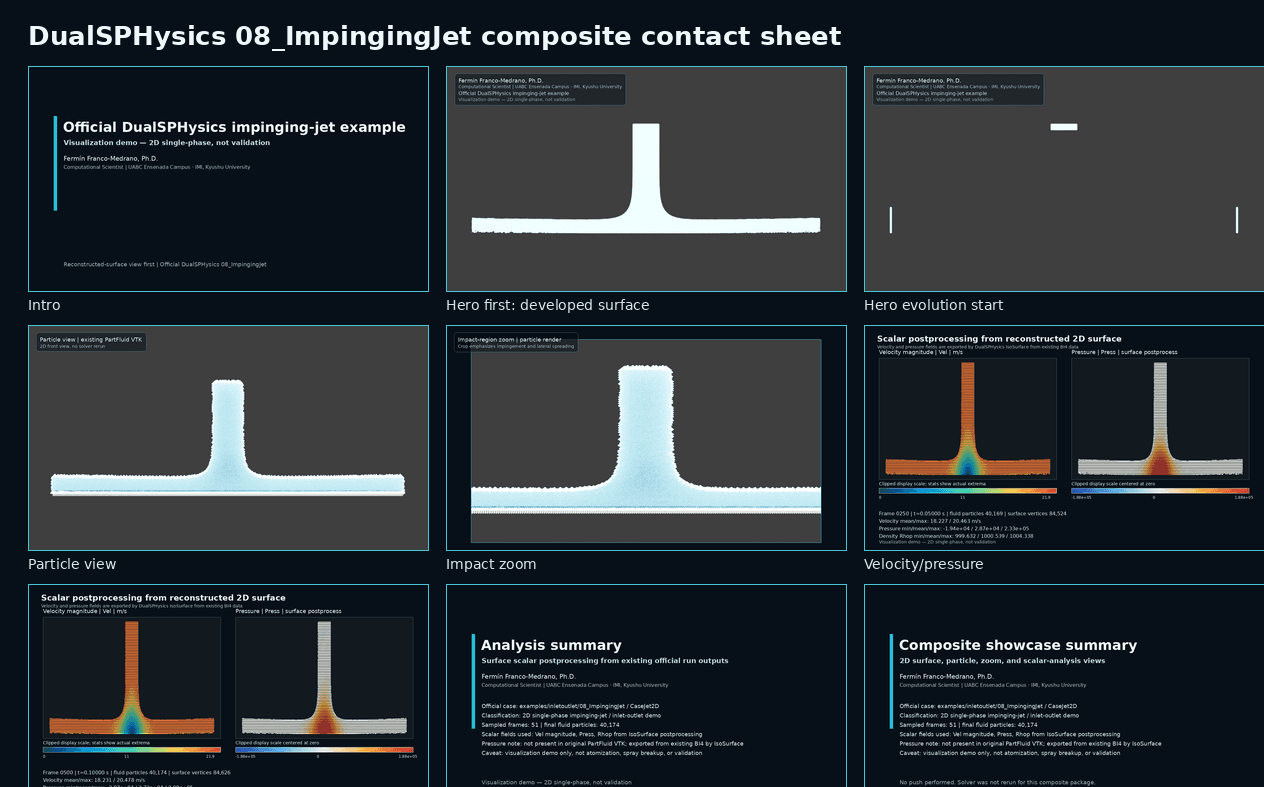
SPH simulation and visualization

A case-study family connecting GPU SPH outputs to reviewable scientific media and a rectangular-jet geometry-proxy handoff.

View project
Question
How can particle-simulation output be turned into interpretable media while preserving model and post-processing context?
Method
DualSPHysics outputs, VTK/IsoSurface post-processing, Blender rendering, and video assembly.
Main output
Hosted visual sequences plus a geometry-metrics handoff to reduced-model analysis tools.
Relationships
The rectangular proxy connects to SprayGeo and Ideal Momentum Jet Explorer analysis paths.
Scientific context
The rectangular sequence is a single-phase geometry proxy used for visualization and geometry-metric extraction.

Scientific visualization media

Finished videos and contact sheets are available on the project pages.

Applied research case studies

These six case studies present the problem, my contribution, method, and result.

2025–2026

Physical characterization of Ensenada wine

Problem
Connect regional wine questions to measurable physical, optical, and fluid-mechanical properties.
Contribution
I provide technical leadership and student mentoring in a UABC collaboration with CEVIT.
Method
Viscosity, rheology, surface tension, drop and column-flow experiments, ultrasound, exploratory optics, and preliminary modeling.
Outcome
An applied research program linking continuum mechanics, physical measurement, and regional industry questions, currently at the exploratory-measurement and initial concept-validation stage.

2025–2026

Wine-region microclimate data system

Problem
Turn heterogeneous weather-station records into comparable agroclimatic data products.
Contribution
I provide technical direction and student mentoring for a UABC–CEVIT pilot.
Method
Python processing, unit normalization, daily and monthly aggregation, exploratory indices, and map-based visualization.
Outcome
A reproducible pilot workflow using partial real data for agroclimatic analysis and decision-support exploration.

2005

Instrumented acoustic quality criterion for automotive fans

Problem
Replace subjective audible-noise inspection with a physical and statistical decision criterion.
Contribution
Under formal supervision, I led the statistical design, signal processing, frequency analysis, decision-rule formulation, and technical report.
Method
Controlled acoustic measurement, FFT spectra, sample comparison, frequency-wise hypothesis tests, and a one-sided Z-test rule.
Outcome
Feasibility demonstrated with real industrial samples.

2016–2017

Kyushu University–Mazda two-phase fuel-tank modeling

Problem
Study liquid–gas behavior associated with filling, return flow, blowback, and early auto-stop.
Contribution
As a postdoctoral researcher, I contributed to modeling, implementation, simulation, verification, analysis, and technical communication.
Method
Diffuse-interface fluid equations, an Allen–Cahn-type phase equation, phase-dependent properties, and FreeFEM++ verification.
Outcome
A verified numerical implementation and preliminary comparison with a simplified two-dimensional experiment.

2013–2016

Water-atomization modeling for the Japanese steel sector

Problem
Relate atomized-jet variables and impact force to particle-size behavior in an industrial research setting.
Contribution
Under university coordination, I contributed mathematical derivation and review, stability analysis, physical interpretation, Python implementation, literature verification, and simulation.
Method
Reduced mathematical models, numerical parameter studies, and comparison with industrially relevant measurements.
Outcome
A computational framework using reduced models, parameter studies, and industrially relevant measurements to interpret jet behavior and impact-force trends.

2017–present

KUMIAY: Japan–Mexico technical and intercultural services

Problem
Connect technical, intercultural, translation, and professional-service needs across Japan and Mexico.
Contribution
As a founding partner and consultant, I connect technical and intercultural know-how, translation expertise, service methods, and professional networks.
Method
Cross-cultural consulting, translation, professional-service design, digital resources, alliances, and business-development practice.
Outcome
Since 2017, I have connected technical and intercultural services across Japan and Mexico through entrepreneurship.

Additional research contexts

These projects add industrial and applied context beside the six case studies above.

2017–2022

Mucociliary and respiratory-epithelium modeling

Model mucociliary and respiratory-epithelium phenomena. Mathematical modeling and computational fluid dynamics.

Research and project leadership connecting Osaka University and UABC work.

2015

Wind-farm wake interaction modeling

Study wake interaction in wind farms. Analytical wake modeling.

Applied modeling in a Kyushu University research context.

2005–2009

Six Sigma process-improvement and quality projects

Improve process and quality decisions. Lean Six Sigma, statistical process control, and design of experiments.

Consulting and instruction through Lean Sigma Academy.